“Austria’s women are taking to the barricades”, wrote the newspaper Bild-Post in 1970. On 27 March 1969, women from both the Social Democratic Party (SPÖ) and the Austrian People’s Party (ÖVP) founded the Austrian Women’s Ring as a cross-party umbrella organization. The occasion was the 50th anniversary of women entering the Austrian Parliament.
The founders – Members of Parliament Lola Solar (ÖVO), Hertha Firnberg and Gertrude Wondrack (SPÖ), Vienna State Parliament member Marga Hubinek (ÖVP) and Hermine Stöckl, chairwoman of the Women Citizien’s Association – shared common goals: to advance women’s equality in all areas of society, to bring women’s issues into public debate, and to increase women’s participation in public life. In addition to exchanging experiences, the organization focused on drafting statements and policy proposals, while also fostering international contacts.
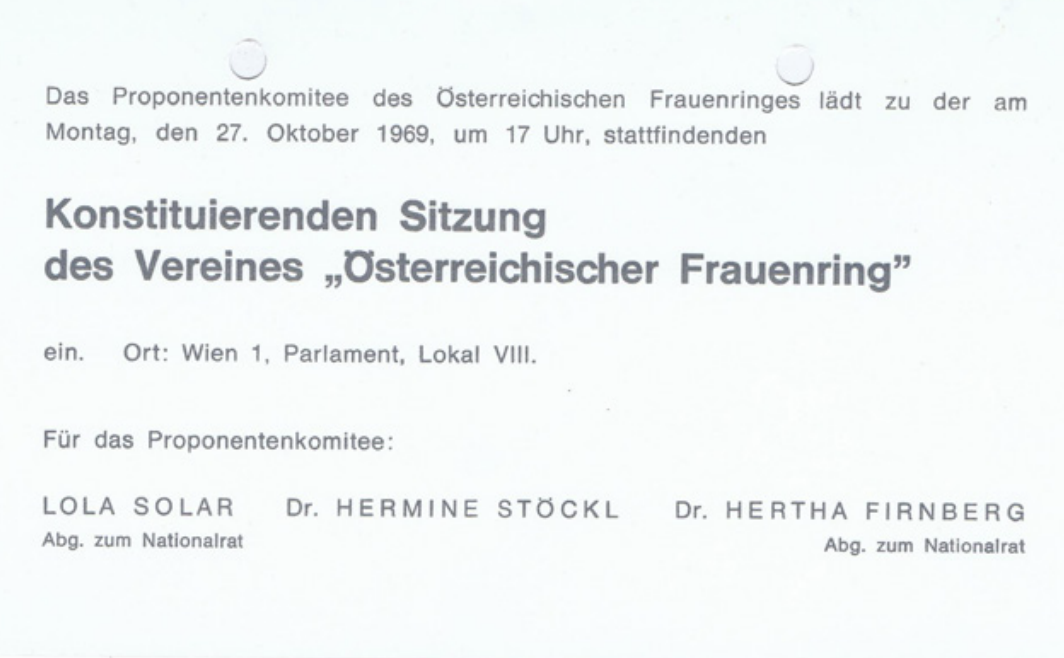
The constituent meeting took place on 27 October 1969. With 100,000 Austrian Schillings in funding (approximately 7,267 €), the women began their work. They organized lectures and conferences, but also contributed to legislative reforms. Key issues on the agenda included family planning and abortion, the legal status of children born outside of marriage, and reforms to family law. Their efforts achieved significant progress: the legal status of children born outside of marriage was gradually improved from 1971 onwards, the time-limit regulation for abortion was introduced in 1975, new family law legislation followed in 1976, and in 1977 the concept of “paternal authority” over children was abolished.
The importance of the Austrian Women’s Ring was recognized by women across party lines. Marilies Flemming (ÖVP) spoke of the “good cooperation between the parliamentary groups […], even though women were exposed to pressure within various political bodies.”
Amendment of the Statutes and Opening of the Austrian Women’s Ring in 1995
Johanna Dohnal (SPÖ), then Minister for Women’s Affairs and chairwoman of the Austrian Women’s Ring, wrote in a letter to autonomous women’s organizations that, in light of Austria’s accession to the European Union and the goal of becoming a member of the European Women’s Lobby, the time had come “to open the Austrian Women’s Ring […] to important women’s organizations and initiatives.”
As early as July 1995, 30 organizations had joined. Many of them remain members today, including the Catholic Women’s Movement, ega:frauen im zentrum, the KPÖ women’s department, Soroptimist Club and ABZ*Austria. Since then, some women’s organization, such as those affiliated with the ÖVP and FPÖ, have left, while many new organizations have joined.
Today with more than 60 member organizations, the Austrian Women’s Ring reflects the diversity of the active women’s movement across all areas of society.